

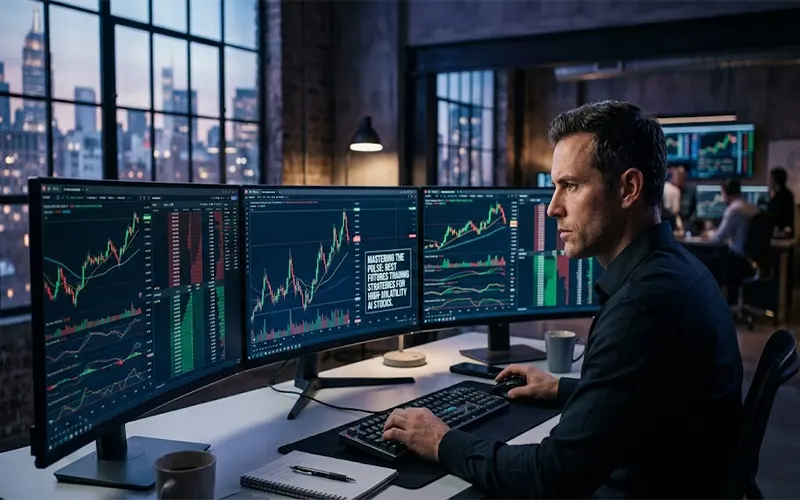
In May 2026, the artificial intelligence sector has transitioned from a speculative frontier into the primary engine of global equity markets. However, this maturity has not brought stability. Instead, as AI-driven algorithmic trading accounts for over 80% of market volume, we are witnessing “algorithmic volatility”—extreme price swings triggered by rapid-fire feedback loops and massive capital expenditure (CapEx) reassessments.
For futures traders, this environment is a double-edged sword. The leverage inherent in futures can amplify gains from these massive moves, but without a sophisticated strategy, the same volatility can lead to rapid liquidations. Below is the 2026 strategic blueprint for trading AI stock futures.
1. The 2026 Market Regime: Beyond the “AI Mention”
Gone are the days when a company could see a 10% stock jump simply by mentioning “Generative AI” in an earnings call. In the current market, investors are hyper-focused on profitability quality and infrastructure ROI.
Recent volatility has been driven by a widening “Hardware-Software Divergence.” While hardware giants (semiconductors and cooling infrastructure) see tangible demand, software firms are facing “disruption risk.” This divergence creates the perfect environment for relative value and spread trading.
2. Top Futures Trading Strategies
A. Adaptive Trend Following (The Volatility Filter)
Traditional trend following often fails in AI markets due to “whipsaws”—sudden reversals that trigger stop-losses before the trend resumes.
- The Strategy: Use an Adaptive Moving Average that adjusts its sensitivity based on market regime. When volatility spikes, the filter “slows down” to avoid noise; when a clear trend emerges, it “speeds up” to capture the meat of the move.
- 2026 Implementation: Integrate Sentiment Analysis into your trend signals. By monitoring real-time developer activity on platforms like GitHub and tracking AI-related policy shifts in the Middle East or DC, traders can filter out “fake” technical breakouts.
B. The Hardware-Software Inter-Sector Spread
As of early 2026, hardware has outperformed software by a staggering margin (approximately 171% to 72% over the trailing year).
- The Strategy: Instead of taking a directional bet on the whole tech sector, trade the Spread.
- The Execution: Go Long on AI Hardware futures (e.g., semiconductor or data center infrastructure indices) while simultaneously going Short on legacy Enterprise Software futures. This market-neutral approach profits from the relative performance difference, protecting you if the entire tech market crashes due to macro factors like Fed interest rate hikes.
C. Algorithmic Pullback Strategy
In a market dominated by AI bots, price action often moves in “pulses.” When a major AI stock breaks out, high-frequency algorithms often cause a rapid, overextended “snap-back” or pullback.
- The Strategy: Use Deep Learning Retracement Models. Instead of standard Fibonacci levels, these models analyze historical order flow to identify where “limit buy” walls are likely sitting.
- The Goal: Enter the trade at the bottom of a 6-hour “flash dip” during an overall bullish trend. This allows for tighter stop-losses and higher Reward-to-Risk ratios.
3. Comparison: Traditional vs. 2026 Adaptive Strategies
| Feature | Traditional Strategy | 2026 Adaptive Strategy |
| Trend Filter | Static (e.g., 50-day SMA) | Dynamic (Volatility-adjusted) |
| Data Source | Price & Volume only | Price + Sentiment + CapEx Trends |
| Risk Model | Fixed percentage per trade | Variable (ATR-based) sizing |
| Exit Logic | Hard Stop-Loss | Algorithmic “Time-decay” exits |
4. Survival of the Fittest: Advanced Risk Management
In high-volatility futures, your risk management system is more important than your entry signal.
Dynamic Position Sizing (ATR)
The Average True Range (ATR) measures how much a stock moves on average. In 2026, the ATR for AI stocks can double in a single day.
- The Rule: Your position size must be inversely proportional to the ATR. If volatility doubles, your contract count should be cut in half to keep your “Value-at-Risk” (VaR) constant.
Hybrid GARCH-LSTM Models
Institutional traders in 2026 are moving toward hybrid models that combine GARCH (which excels at identifying volatility clustering) with Long Short-Term Memory (LSTM) neural networks (which capture non-linear patterns). These models help predict “tail risk”—the probability of a 5-standard-deviation move that could wipe out a leveraged account.
5. Trader’s Checklist for High-Volatility Days
Before opening a position in AI futures today, verify the following:
- Check the “Volatility Surface”: Is the volatility spike driven by an earnings rumor or a macro-economic shift (e.g., FOMC dissent)?
- Verify API Latency: In high-speed markets, a 50ms delay in your execution can be the difference between profit and a slippage-induced loss.
- Review the “Disruptor vs. Disruptee” Status: Is the company you are trading currently being disrupted by a new LLM release? If so, technical support levels may not hold.
- Confirm Correlation: Is the stock moving in tandem with the NQ (Nasdaq) futures, or is it de-coupling? De-coupling often signals a massive individual move is imminent.
Trading AI futures in 2026 requires a transition from “chart reading” to “regime sensing.” By utilizing adaptive filters and focusing on inter-sector spreads, traders can navigate the turbulence of the AI build-out and turn extreme volatility into a structured path for profit.