


Master Your Cash Flow: How to Refinance a Car Loan to Lower Monthly Payments (2026 Edition)

Master Your Cash Flow: How to Refinance a Car Loan to Lower Monthly Payments (2026 Edition)

In the economic landscape of May 2026, many vehicle owners are finding themselves “over-leveraged” by loans taken out during the high-inflation peaks of previous years. With the Federal Reserve currently in a “shallow easing” cycle, interest rates have finally begun to retreat. For many, this has opened a strategic window to refinance.

Refinancing isn’t just about getting a new loan; it’s about restructuring your debt to better align with your current financial goals. Whether you’ve seen a significant boost in your credit score or simply need to breathe some life back into your monthly budget, here is the masterclass on lowering your car payments in 2026.

1. The 2026 Refinance Climate: Rates & Opportunities

As of May 2026, the benchmark for “excellent” credit refinance rates is starting as low as 5.24% APR. However, the most important metric for any borrower is the “50-Point Rule.”

If your credit score has …

Master Your Cash Flow: How to Refinance a Car Loan to Lower Monthly Payments (2026 Edition) Read More

Strategic Fleet Financing: Balloon Payment vs. Traditional Auto Loan for Business (2026 Edition)

Strategic Fleet Financing: Balloon Payment vs. Traditional Auto Loan for Business (2026 Edition)

In the current 2026 economic landscape, business owners are navigating a “Shallow Easing” cycle—a period where interest rates are retreating from their peaks, but operational costs remain stubbornly high. For Small and Medium Enterprises (SMEs), the primary objective has shifted from aggressive expansion to liquidity preservation.

The vehicle financing market has responded with more nuanced structures. Furthermore, with the 2025 passage of the “One Big Beautiful Bill Act” (OBBBA), the tax implications of interest deductions have changed for 2026, making the choice between a balloon payment and a traditional loan a critical CFO-level decision.

1. Traditional Auto Loans: The “Safe & Steady” Path

A traditional amortized loan is the bedrock of business financing. In this structure, each monthly payment is divided between principal and interest, ensuring that the loan balance decreases predictably over time.

The Advantages for Business

  • Equity Accumulation: From month one, the business is building equity in
Strategic Fleet Financing: Balloon Payment vs. Traditional Auto Loan for Business (2026 Edition) Read More
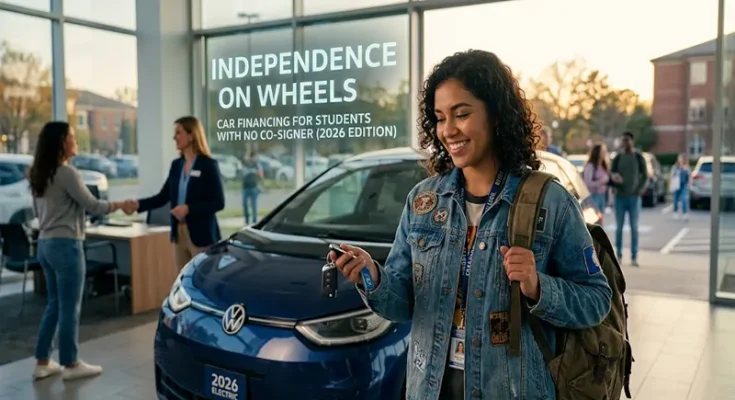
Independence on Wheels: Car Financing for Students with No Co-signer (2026 Edition)

Independence on Wheels: Car Financing for Students with No Co-signer (2026 Edition)

Securing a car loan as a student has always been a “chicken or the egg” dilemma: you need a car to get to the job that pays for the car, but you can’t get the loan without the credit history that the job helps you build. In 2026, this challenge is compounded by a cautious lending market and higher-than-average interest rates.

However, the “solo” path to vehicle ownership is more accessible today than in previous decades, thanks to new credit-scoring technologies and specialized student programs. If you don’t have a co-signer to bridge the gap, you aren’t out of luck—you just need a more calculated strategy.

1. The 2026 “Solo” Reality: Beyond the FICO Score

The biggest hurdle for students is a “thin” credit file. Traditionally, if a lender didn’t see a five-year history of credit card payments, they walked away. In 2026, the landscape has shifted toward Alternative Credit

Independence on Wheels: Car Financing for Students with No Co-signer (2026 Edition) Read More
Navigating the Golden State: Affordable Used Car Finance Companies in California (2026 Edition)

Navigating the Golden State: Affordable Used Car Finance Companies in California (2026 Edition)

In May 2026, California’s used car market remains one of the most dynamic and competitive in the nation. While the “post-pandemic” price surges have finally stabilized, high demand in the Inland Empire and Central Valley, combined with shifting interest rate cycles, makes finding the right lender as critical as finding the right car.

Furthermore, 2026 marks a historic turning point for California consumers. With the full implementation of the California Combating Auto Retail Scams (CARS) Act, buyers from Sacramento to San Diego now have more transparency and protection than ever before. This guide highlights the most affordable lenders in the state and explains how to leverage new laws to save thousands.

1. The 2026 California Advantage: Understanding the CARS Act

Before looking at lenders, it is vital to understand your new rights. As of October 2026, California law has significantly reined in “junk fees” and deceptive practices.

  • The “Total
Navigating the Golden State: Affordable Used Car Finance Companies in California (2026 Edition) Read More
Driving the Future: Navigating the Best Low-Interest EV Financing Terms

Driving the Future: Navigating the Best Low-Interest EV Financing Terms

The electric vehicle (EV) market of May 2026 looks vastly different than it did even two years ago. With the expiration of the original federal tax credit (IRC 30D) at the end of 2025, the burden of maintaining sales momentum has shifted from the government to the automakers themselves. To combat high interest rates and the “post-subsidy slump,” manufacturers have launched an unprecedented era of aggressive captive financing.

For savvy buyers, May 2026 represents a “golden window.” Dealerships are currently clearing out 2025 inventory to make room for 2027 models, leading to a surge in 0% APR offers and stackable incentives that can often outweigh the old tax credits.

1. The May 2026 Financing Landscape: Captive vs. Traditional

In the current economic climate, traditional banks are still hovering around 6.5% to 8% for standard auto loans. However, EV manufacturers are utilizing their own financing arms (Captive Lenders) to subsidize rates …

Driving the Future: Navigating the Best Low-Interest EV Financing Terms Read More