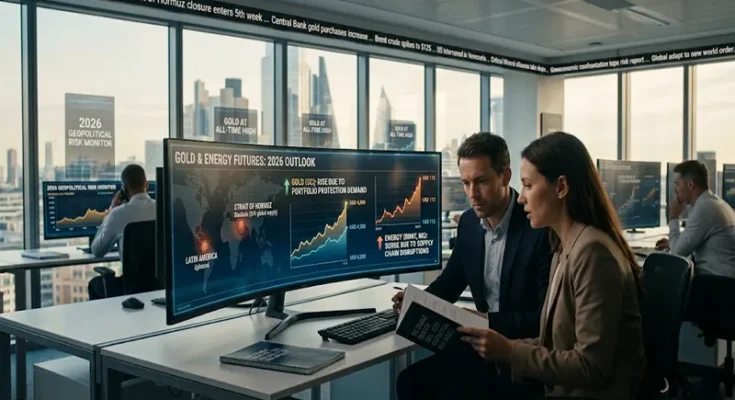
The Fragile Frontier: Impact of 2026 Geopolitical Risks on Gold and Energy Futures

The Fragile Frontier: Impact of 2026 Geopolitical Risks on Gold and Energy Futures

As of May 2026, the global commodities market is navigating a “Dual-Shock” environment that has dismantled traditional valuation models. Investors are no longer merely pricing in supply and demand; they are pricing in the survival of maritime corridors and the stability of the global reserve system. With gold testing the $5,000/oz threshold and energy futures grappling with the most severe Middle East supply disruptions since 2022, the 2026 macro landscape is one of high-stakes volatility.

According to the World Bank’s April 2026 Commodity Markets Outlook, global commodity prices are projected to rise 16% this year, with energy prices alone surging 24%. This “Geopolitical Risk Premium” is the primary driver of price action, as the world moves from a period of globalization to one of “Resource Securitization.”

1. Energy Futures: The “Hormuz Risk Premium”

The defining feature of the 2026 energy market is the contested nature of the Strait of …

The Fragile Frontier: Impact of 2026 Geopolitical Risks on Gold and Energy Futures Read More
Capturing the Edge: Profitable Overnight Futures Trading Setups for S&P 500 Index

Capturing the Edge: Profitable Overnight Futures Trading Setups for S&P 500 Index

In the trading world of 2026, the “Overnight Edge” has transitioned from a statistical curiosity to a cornerstone of institutional and professional retail strategy. Research has consistently shown that the vast majority of the S&P 500’s capital appreciation over the last several decades has occurred while the New York Stock Exchange was closed.

As global markets become more interconnected—driven by 24/5 liquidity in Asian hubs like Singapore and the rising dominance of European equity flows—the “Globex” session (6:00 PM to 9:30 AM ET) offers a smoother, less noisy environment for traders who know where to look.

1. The Mathematics of the Night: Why Trade Globex?

The “Overnight Edge” exists primarily due to how information is digested. While the regular session (RTH) is characterized by high-frequency noise and retail emotional swings, the overnight session reflects the positioning of global institutions and the reaction to international macro events.

In 2026, the expansion …

Capturing the Edge: Profitable Overnight Futures Trading Setups for S&P 500 Index Read More
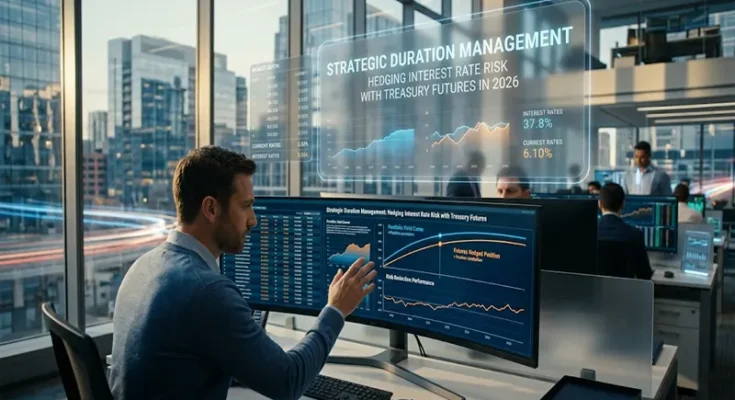
Strategic Duration Management: Hedging Interest Rate Risk with Treasury Futures in 2026

Strategic Duration Management: Hedging Interest Rate Risk with Treasury Futures in 2026

The fixed-income landscape of May 2026 is defined by a historic transition in monetary leadership and a “shallow easing” cycle that has kept volatility at institutional highs. With Kevin Warsh succeeding Jerome Powell as Federal Reserve Chair, the market is grappling with a new regime of “transparent data-dependence,” where the traditional “Fed Put” has been replaced by a focus on supply-side resilience.

For portfolio managers and corporate treasurers, this environment demands more than passive bond holding. To protect capital against the “steepening bias” of the 2026 yield curve, the use of U.S. Treasury futures is no longer optional—it is a mechanical necessity for neutralizing duration and isolating credit spreads.

1. The 2026 Macro Catalyst: The “Warsh” Regime and Sticky Yields

As of Q2 2026, the Federal Reserve has initiated a cautious easing cycle, yet long-term yields remain stubborn. J.P. Morgan (2025) and Morgan Stanley (2026) have noted that “stealth quantitative …

Strategic Duration Management: Hedging Interest Rate Risk with Treasury Futures in 2026 Read More
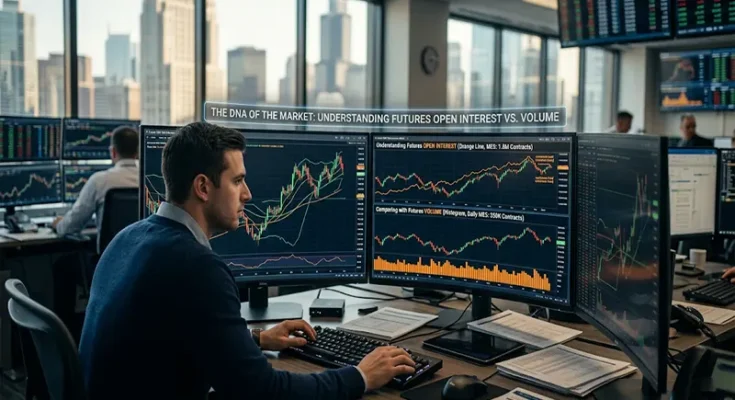
The DNA of the Market: Understanding Futures Open Interest vs. Volume

The DNA of the Market: Understanding Futures Open Interest vs. Volume

In the high-speed, AI-driven markets of 2026, price action alone is often a deceptive indicator. To distinguish between a sustainable institutional trend and a fleeting retail “pump,” professional futures traders look beneath the surface at two critical metrics: Volume and Open Interest (OI).

While volume tells you how much “noise” or activity is in the market, open interest tells you how much “conviction” or new capital is actually staying there. Mastering the interaction between these two is the closest a trader can get to seeing the “Smart Money” footprints in real-time.

1. Defining the Duo: Activity vs. Conviction

To understand trend confirmation, we must first separate these two often-confused terms.

  • Volume: This is the total number of contracts traded during a specific period (usually a single trading session). If Trader A buys 5 contracts and Trader B sells 5 contracts to them, the volume is 5. Volume measures the
The DNA of the Market: Understanding Futures Open Interest vs. Volume Read More
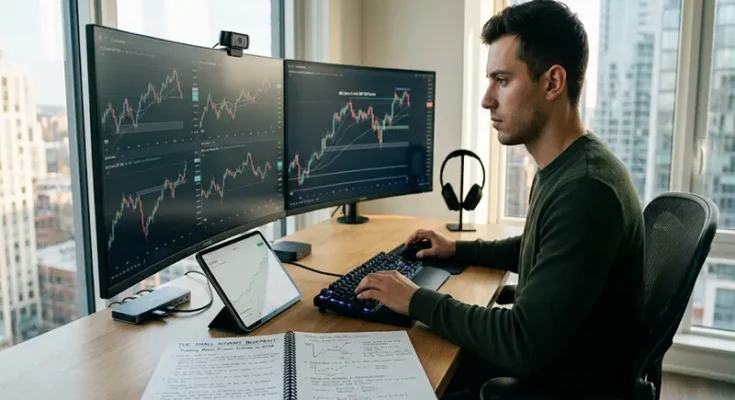
The Small Account Blueprint: Trading Micro E-mini Futures in 2026

The Small Account Blueprint: Trading Micro E-mini Futures in 2026

For a long time, the futures market was the playground of institutional giants and “high-net-worth” retail traders. The standard E-mini S&P 500 ($ES$) contract, with its $\$50$ per point value, could wipe out a small account in a matter of minutes. However, the “Micro” revolution has fundamentally changed the game.

In 2026, Micro E-mini contracts ($MES$ for the S&P 500 and $MNQ$ for the Nasdaq-100) have become the primary vehicle for retail traders with balances between $\$500$ and $\$5,000$. These contracts allow you to practice professional-grade risk management while accessing the most liquid markets in the world.

1. Understanding the “Micro” Edge

The primary appeal of Micro E-mini futures is their size. They are exactly 1/10th the size of a standard E-mini contract. This reduction in size isn’t just about lower entry costs; it’s about granularity.

With a small account, you cannot “scale out” of a single standard contract. …

The Small Account Blueprint: Trading Micro E-mini Futures in 2026 Read More