

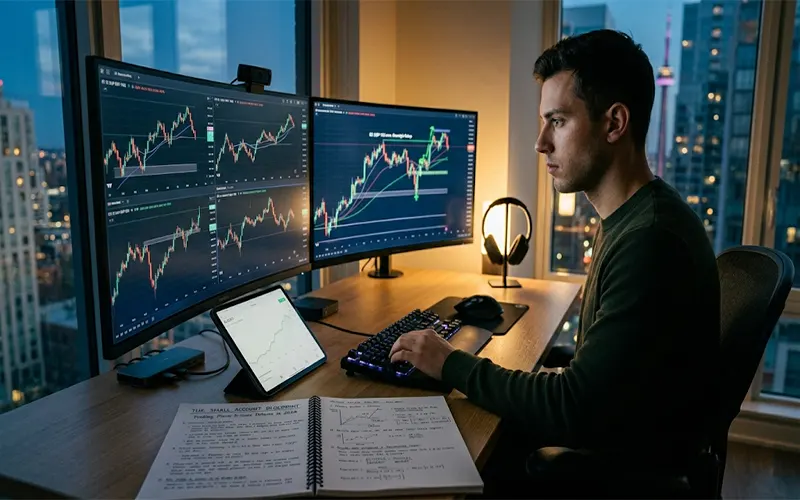
In the trading world of 2026, the “Overnight Edge” has transitioned from a statistical curiosity to a cornerstone of institutional and professional retail strategy. Research has consistently shown that the vast majority of the S&P 500’s capital appreciation over the last several decades has occurred while the New York Stock Exchange was closed.
As global markets become more interconnected—driven by 24/5 liquidity in Asian hubs like Singapore and the rising dominance of European equity flows—the “Globex” session (6:00 PM to 9:30 AM ET) offers a smoother, less noisy environment for traders who know where to look.
1. The Mathematics of the Night: Why Trade Globex?
The “Overnight Edge” exists primarily due to how information is digested. While the regular session (RTH) is characterized by high-frequency noise and retail emotional swings, the overnight session reflects the positioning of global institutions and the reaction to international macro events.
In 2026, the expansion of 24/5 liquidity has reduced the “bid-ask spread” during the early morning hours, making it viable for retail traders to participate. Trading the night allows you to bypass the “opening bell” volatility that often triggers stop-losses before a trend is even established.
2. The Infrastructure: Capital Efficiency in 2026
For most traders, the Micro E-mini S&P 500 ($MES$) is the preferred tool for overnight setups. With a contract size $1/10th$ of the standard E-mini ($ES$), it allows for more granular risk management.
- Margin Efficiency: Many 2026 brokers offer reduced intraday margins for Globex, though traders must be mindful of the higher “Maintenance Margin” required to hold positions through the 5:00 PM ET daily close.
- Low Latency: Execution speed is critical. Utilizing 2026-standard platforms like ApexFutures ensures that your orders are routed with sub-millisecond precision, which is vital during the thinner liquidity of the 2:00 AM ET “dead zone.”
3. Setup #1: The Mean Reversion Gap Fill
This setup exploits the tendency of the S&P 500 to “snap back” to its average price after an emotional sell-off during the regular session.
- The Logic: If the market closes near a 10-day low with an Internal Bar Strength (IBS) ratio below 0.5, the market is technically “oversold.”
- The Entry: Buy 1-2 $MES$ contracts at the 4:00 PM ET close or immediately upon the 6:00 PM ET Globex open.
- The Exit: Sell at the 9:30 AM ET open the following morning.
- 2026 Nuance: Filter this trade with the 200-day Moving Average. In a primary bull market, this “buy the dip” overnight setup has an incredibly high win rate. In a primary bear market, the risk of a “gap down” overnight is significantly higher.
4. Setup #2: The European Open Breakout
The “London Session” (starting at 3:00 AM ET) often acts as the true trend-setter for the U.S. pre-market. This setup looks for a breakout of the quiet Asian session range.
- The Setup: Identify the high and low of the “Overnight Range” established between 6:00 PM ET and 3:00 AM ET.
- The Entry: Buy a breakout of the high (or sell a breakdown of the low) as London opens.
- The Target: The prior day’s regular session settlement price or high/low.
- Indicators: Use VWAP (Volume Weighted Average Price). If the price is trending above VWAP during the London open, the bias is strictly long.
5. Setup #3: The Pre-Market Macro Fade
By 8:30 AM ET, the market receives high-impact economic data (CPI, Payrolls, or Fed Speak). This often creates “exhaustion gaps” that savvy traders can fade.
- The Scenario: A major news event causes the S&P 500 to rally +1% or more before 9:00 AM ET.
- The Logic: Institutions often use this pre-market liquidity to sell into the strength before retail traders can participate at the 9:30 AM open.
- The Entry: Look for a “lower high” on a 5-minute chart between 8:45 AM and 9:15 AM ET. Short $MES$ with a tight stop above the news high.
- The Goal: A “reversion to the mean” (the price before the news was released).
6. Regular Session vs. Overnight Volatility (2026 Estimates)
| Metric | Regular Session (9:30-4:00) | Overnight Session (6:00-9:30) |
| Typical Range | 1.2% – 2.5% | 0.5% – 1.1% |
| Liquidity | Extremely High | Moderate to High |
| Noise Level | High (Algorithmic) | Low (Macro-Driven) |
| Primary Driver | Corporate News / NYSE Flow | Global Macro / Yield Curves |
7. Risk Management & The “Hidden” Costs
Trading overnight is not without peril. Liquidity is thinner than the regular session, which can lead to “slippage.”
- Limit Orders Only: Never use market orders during Globex. A market order at 3:00 AM could be filled several points away from your intended price.
- The “Gap” Risk: While stop-losses are active during Globex, a catastrophic global event can cause the market to “gap” past your stop. Always size positions small enough that a 2% gap against you doesn’t ruin your account.
- Swap Fees: If you are trading CFDs rather than regulated futures, be aware of “overnight swap” or financing fees that can eat into your profits. In 2026, regulated $MES$ futures remain the most cost-effective path.
8. The 30-Day Night Watch
To successfully trade the S&P 500 overnight, you must adapt to a different pace. Start by observing the London open (3:00 AM ET) for a week without placing a trade. Watch how the Volume Profile develops and how price reacts to the overnight VWAP.
By shifting your focus to these high-probability setups—Mean Reversion, the London Breakout, and the Macro Fade—you can capture the “Overnight Edge” and build a trading business that operates while the rest of the world is asleep.