
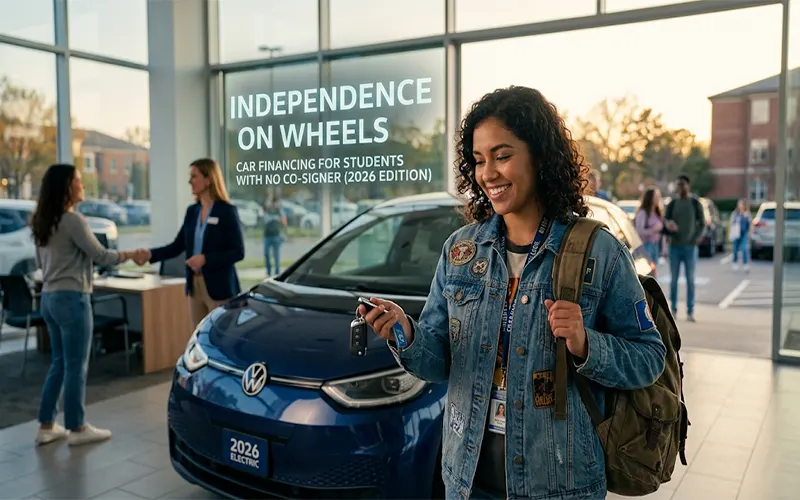
Securing a car loan as a student has always been a “chicken or the egg” dilemma: you need a car to get to the job that pays for the car, but you can’t get the loan without the credit history that the job helps you build. In 2026, this challenge is compounded by a cautious lending market and higher-than-average interest rates.
However, the “solo” path to vehicle ownership is more accessible today than in previous decades, thanks to new credit-scoring technologies and specialized student programs. If you don’t have a co-signer to bridge the gap, you aren’t out of luck—you just need a more calculated strategy.
1. The 2026 “Solo” Reality: Beyond the FICO Score
The biggest hurdle for students is a “thin” credit file. Traditionally, if a lender didn’t see a five-year history of credit card payments, they walked away. In 2026, the landscape has shifted toward Alternative Credit Data.
Lenders now frequently use FICO 10T or VantageScore 4.0, which look at “trended data.” This means they can see your history of on-time rent payments, utility bills, and even your consistent Netflix or Spotify subscriptions. For a student with no co-signer, this digital footprint acts as your primary “character witness” to prove you are a reliable borrower.
2. Building Your Case: The “No Co-signer” Toolkit
Without a co-signer to act as a safety net, the lender is looking solely at you to mitigate their risk. Here is how you build a “bulletproof” application:
Proof of Steady Income
Lenders in 2026 generally look for a minimum gross income of $1,500 to $1,800 per month. If you aren’t working a traditional 9-to-5, you can use:
- 1099 Side-Hustle Income: Consistent earnings from delivery apps or freelance platforms.
- Stipends and Work-Study: Official documentation of academic-related income.
- Internship Contracts: A signed offer letter for an upcoming paid internship can often serve as proof of future earnings.
The Down Payment “Equalizer”
A down payment is the ultimate substitute for a co-signer. By putting down 15% to 20% of the car’s price, you reduce the “Loan-to-Value” ratio. This makes the lender feel safer because you have immediate equity in the vehicle. If you’re looking at a $15,000 used car, having $3,000 in cash significantly increases your approval odds.
The “Good Student” Discount
Believe it or not, your GPA can lower your interest rate. Many 2026 lenders offer “Academic Excellence” tiers. If you maintain a 3.0 GPA or higher, lenders view you as statistically more disciplined and likely to have higher future earning potential, which can shave 1–2% off your APR.
3. Strategic Lender Selection
Where you apply is just as important as the application itself. Avoid the “Apply Everywhere” approach, which can ding your credit score with multiple hard inquiries.
- Credit Unions: Local or student-affiliated credit unions are member-owned. They are far more likely to look at the “whole person” rather than just a score.
- Captive Finance Grad Programs: Manufacturers like Toyota, Honda, and Ford have 2026 programs specifically for students within six months of graduation (or recent grads). These programs often waive the co-signer requirement if you have a confirmed job offer.
- Specialized Fintechs: Platforms like Boro or Earnest use AI to look at your major and career path to predict your ability to pay, rather than relying on a 20th-century credit model.
4. The Math of the Student Loan
It is easy to get caught up in the excitement of a new car, but the math must work. As a student, you are likely already balancing tuition or cost-of-living expenses.
The 20/4/10 Rule for Students
- 20% Down: To avoid being “underwater” (owing more than the car is worth).
- 4-Year Term: Avoid 72 or 84-month loans. While the monthly payment looks small, you will pay thousands more in interest.
- 10% of Income: Your total car costs (payment + insurance + fuel) should never exceed 10% of your take-home pay.
Auto Loan vs. Student Loan: A Comparison
| Feature | Auto Loan | Student Loan (Refinance for Car) |
| Collateral | The car (can be repossessed). | None (generally unsecured). |
| Interest Rate (2026) | 10% – 14% (No co-signer). | 6% – 9% (Federal/Private). |
| Impact of Default | Immediate loss of transport. | Wage garnishment/Long-term credit damage. |
| Credit Building | High (reports to all 3 bureaus). | Moderate. |
5. Avoiding the Predatory “Student Traps”
When you have no co-signer, you may feel desperate. This is when predatory lenders strike.
- “Buy Here, Pay Here” Lots: These dealers often charge 25%+ interest and, more importantly, do not report to credit bureaus. You could pay off the whole car and your credit score wouldn’t move an inch.
- The Insurance Spike: Remember that a “solo” loan requires Full Coverage Insurance. For a driver under 25, this can easily cost $200–$300 per month. Always get an insurance quote before signing the loan.
6. Your Roadmap to Approval: A 5-Step Checklist
Before you set foot on a dealership lot, check these boxes to ensure you’re ready to fly solo:
- [ ] Audit Your “Alt-Credit”: Use a service like Experian Boost to ensure your phone and rent payments are being reported.
- [ ] Secure Your Paperwork: Have your last three months of bank statements and a current school transcript ready.
- [ ] Get Pre-Approved: Apply at a credit union first. If they say no, ask why. This feedback is gold for fixing your application.
- [ ] The “Boring Car” Strategy: Lenders are more likely to approve a loan for a 4-year-old Toyota Corolla than a 10-year-old BMW. Choose reliability to lower the lender’s risk.
- [ ] Calculate TCO: Use a Total Cost of Ownership calculator to ensure you can afford the “extras” like registration, maintenance, and gas.
Financing a car without a co-signer is a milestone of adulthood. By leveraging your academic success, building a cache of alternative credit data, and choosing a reliable, modest vehicle, you can secure the mobility you need while building a credit foundation that will serve you for decades to come.